MABE | Esti Maxi Skirt in Blue Blockprint
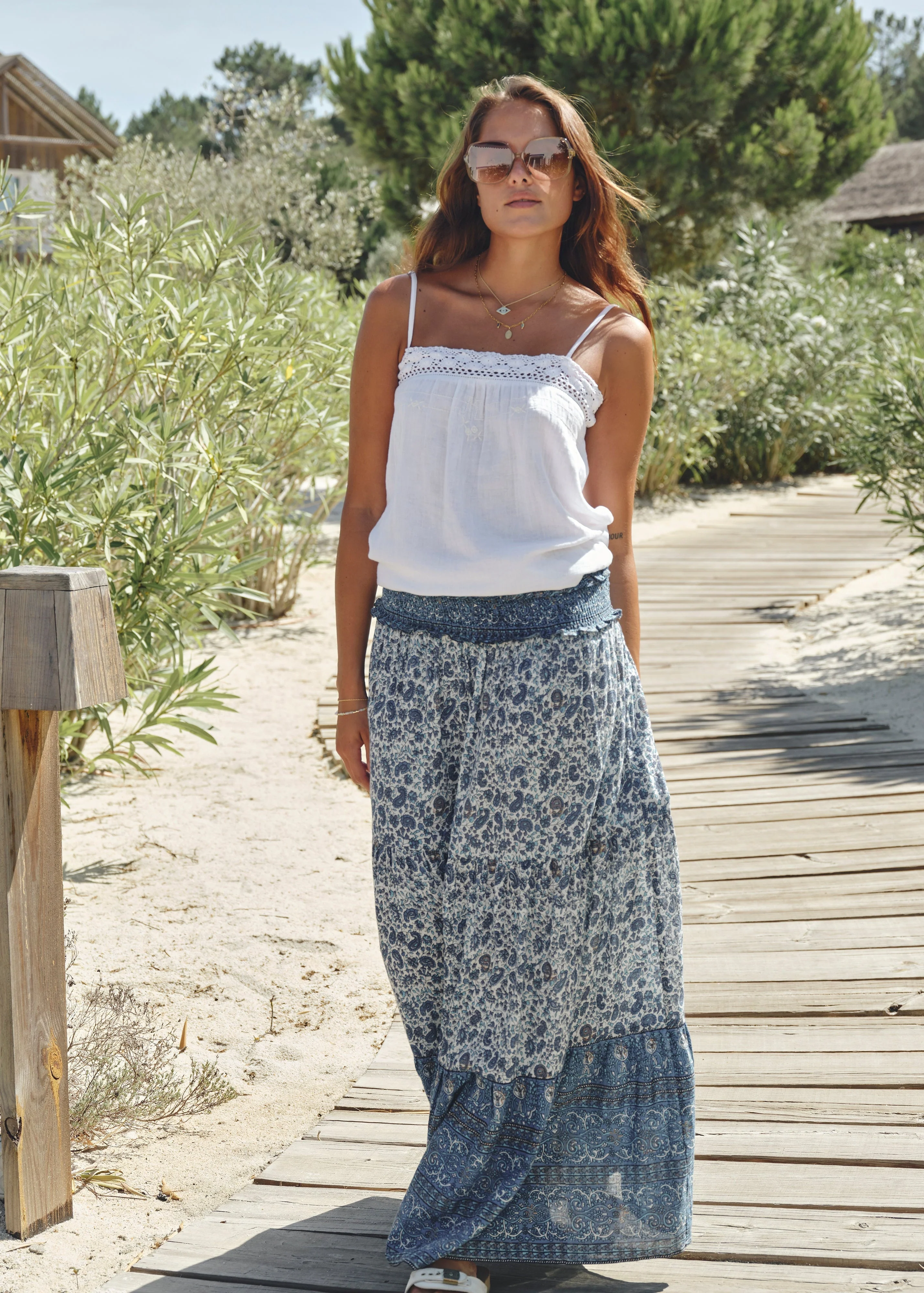
There is a particular intelligence in how MABE treats volume—not as an afterthought, but as the primary architecture of a garment. The Esti Maxi Skirt demonstrates this with a tiered silhouette that builds proportion from waist to hem in deliberate, generous increments. It is a skirt that announces itself through shape alone: three horizontal bands of cotton, each tier slightly wider than the last, creating a graduated fullness that feels both sculptural and effortless. The blockprint pattern is tonal rather than stark—a floral and border motif rendered in subtle gradations of blue that read as a single wash of color rather than a graphic statement. This restraint is what separates a considered design from a mere print. The cotton itself is key to the skirt’s character. Lightweight but not flimsy, it has the dry, clean hand of a well-milled fabric that holds its shape without stiffness. There is no synthetic stretch here, no glossy finish—just the honest texture of natural fiber against skin. The fabric breathes, which makes the skirt as suitable for a humid afternoon as it is for a layered winter look. The blockprint sits on the surface without compromising the cloth’s softness; you feel the cotton before you see the pattern. This is a garment that rewards touch. Construction is where MABE reveals its precision. The waistband is elasticated but finished with a gathered frill that softens the transition from body to skirt. This is not a sporty elastic pull-on; the frill introduces a deliberate femininity, a nod to romantic dressing that never tips into costume. The waist sits at the natural waistline, anchored there by the elastic, while the skirt falls away in a free-flowing A-line. The tiered seams are stitched cleanly, each one reinforcing the volume rather than interrupting it. The maxi length lands somewhere between ankle and floor, depending on height, which is the sweet spot for a skirt that wants to move with you rather than trip you. Movement is the point. In still air, the Esti drapes in soft, vertical folds; in motion, each tier separates and resettles like layers of a curtain caught in a breeze. The weight of the cotton pulls the hem down, so the skirt never balloons or flies up. It swishes, it settles, it swings. This is a skirt for walking through a gallery, for a late lunch where the chairs are low and the wine is chilled, for a train platform in early autumn. It does not demand a specific occasion because it creates its own. Styling it means respecting its proportions. Tuck a fine-gauge cashmere sweater in white or ecru into the frill waist—the contrast of dense knit against airy cotton is a study in texture. Or wear it with a slim silk camisole and flat leather sandals for a silhouette that is all vertical line. In cooler months, try a cropped wool jacket and a low boot; the skirt’s volume will balance a tailored top half. The blue is neutral enough to sit beside black, navy, cream, or rust. Let the skirt be the event. Everything else is just setting.
Product Information
Product Information
Shipping & Returns
Shipping & Returns



MABE | Esti Maxi Skirt in Blue Blockprint
MABE | Esti Maxi Skirt in Blue Blockprint
There is a particular intelligence in how MABE treats volume—not as an afterthought, but as the primary architecture of a garment. The Esti Maxi Skirt demonstrates this with a tiered silhouette that builds proportion from waist to hem in deliberate, generous increments. It is a skirt that announces itself through shape alone: three horizontal bands of cotton, each tier slightly wider than the last, creating a graduated fullness that feels both sculptural and effortless. The blockprint pattern is tonal rather than stark—a floral and border motif rendered in subtle gradations of blue that read as a single wash of color rather than a graphic statement. This restraint is what separates a considered design from a mere print. The cotton itself is key to the skirt’s character. Lightweight but not flimsy, it has the dry, clean hand of a well-milled fabric that holds its shape without stiffness. There is no synthetic stretch here, no glossy finish—just the honest texture of natural fiber against skin. The fabric breathes, which makes the skirt as suitable for a humid afternoon as it is for a layered winter look. The blockprint sits on the surface without compromising the cloth’s softness; you feel the cotton before you see the pattern. This is a garment that rewards touch. Construction is where MABE reveals its precision. The waistband is elasticated but finished with a gathered frill that softens the transition from body to skirt. This is not a sporty elastic pull-on; the frill introduces a deliberate femininity, a nod to romantic dressing that never tips into costume. The waist sits at the natural waistline, anchored there by the elastic, while the skirt falls away in a free-flowing A-line. The tiered seams are stitched cleanly, each one reinforcing the volume rather than interrupting it. The maxi length lands somewhere between ankle and floor, depending on height, which is the sweet spot for a skirt that wants to move with you rather than trip you. Movement is the point. In still air, the Esti drapes in soft, vertical folds; in motion, each tier separates and resettles like layers of a curtain caught in a breeze. The weight of the cotton pulls the hem down, so the skirt never balloons or flies up. It swishes, it settles, it swings. This is a skirt for walking through a gallery, for a late lunch where the chairs are low and the wine is chilled, for a train platform in early autumn. It does not demand a specific occasion because it creates its own. Styling it means respecting its proportions. Tuck a fine-gauge cashmere sweater in white or ecru into the frill waist—the contrast of dense knit against airy cotton is a study in texture. Or wear it with a slim silk camisole and flat leather sandals for a silhouette that is all vertical line. In cooler months, try a cropped wool jacket and a low boot; the skirt’s volume will balance a tailored top half. The blue is neutral enough to sit beside black, navy, cream, or rust. Let the skirt be the event. Everything else is just setting.
Product Information
Product Information
Shipping & Returns
Shipping & Returns
Description
There is a particular intelligence in how MABE treats volume—not as an afterthought, but as the primary architecture of a garment. The Esti Maxi Skirt demonstrates this with a tiered silhouette that builds proportion from waist to hem in deliberate, generous increments. It is a skirt that announces itself through shape alone: three horizontal bands of cotton, each tier slightly wider than the last, creating a graduated fullness that feels both sculptural and effortless. The blockprint pattern is tonal rather than stark—a floral and border motif rendered in subtle gradations of blue that read as a single wash of color rather than a graphic statement. This restraint is what separates a considered design from a mere print. The cotton itself is key to the skirt’s character. Lightweight but not flimsy, it has the dry, clean hand of a well-milled fabric that holds its shape without stiffness. There is no synthetic stretch here, no glossy finish—just the honest texture of natural fiber against skin. The fabric breathes, which makes the skirt as suitable for a humid afternoon as it is for a layered winter look. The blockprint sits on the surface without compromising the cloth’s softness; you feel the cotton before you see the pattern. This is a garment that rewards touch. Construction is where MABE reveals its precision. The waistband is elasticated but finished with a gathered frill that softens the transition from body to skirt. This is not a sporty elastic pull-on; the frill introduces a deliberate femininity, a nod to romantic dressing that never tips into costume. The waist sits at the natural waistline, anchored there by the elastic, while the skirt falls away in a free-flowing A-line. The tiered seams are stitched cleanly, each one reinforcing the volume rather than interrupting it. The maxi length lands somewhere between ankle and floor, depending on height, which is the sweet spot for a skirt that wants to move with you rather than trip you. Movement is the point. In still air, the Esti drapes in soft, vertical folds; in motion, each tier separates and resettles like layers of a curtain caught in a breeze. The weight of the cotton pulls the hem down, so the skirt never balloons or flies up. It swishes, it settles, it swings. This is a skirt for walking through a gallery, for a late lunch where the chairs are low and the wine is chilled, for a train platform in early autumn. It does not demand a specific occasion because it creates its own. Styling it means respecting its proportions. Tuck a fine-gauge cashmere sweater in white or ecru into the frill waist—the contrast of dense knit against airy cotton is a study in texture. Or wear it with a slim silk camisole and flat leather sandals for a silhouette that is all vertical line. In cooler months, try a cropped wool jacket and a low boot; the skirt’s volume will balance a tailored top half. The blue is neutral enough to sit beside black, navy, cream, or rust. Let the skirt be the event. Everything else is just setting.