XIWIKJ | Dancing-Queens Silk Square Scarf - Watercolour Motif
This is not a scarf that merely sits at the neck; it is one that claims its own airspace. The XIWIKJ Dancing-Queens scarf announces itself through a deliberate, generous square silhouette that refuses to be folded into submission. Its proportions are those of a statement piece—ample enough to be worn as a dramatic top knotted at the sternum, generous enough to cascade over the shoulders of a black wool coat, or substantial enough to be tied as a sculptural headwrap that frames the face with intention. The edges are cleanly finished, precise, allowing the silk to fall without distraction. The hand of this silk is where the story deepens. It moves with a liquid weight that is neither flimsy nor stiff—a rare equilibrium that speaks to a higher grade of mulberry silk. When held, the fabric offers a cool, smooth resistance before releasing into a soft drape that catches the light in uneven, painterly flashes. The weave is tight yet breathable, the surface luminous without being glossy. It whispers against the skin, a sensation that elevates the act of dressing from routine to ritual. Construction here is deceptively simple: a pure square of silk, printed with a motif that suggests motion—abstracted figures in a state of perpetual dance, their limbs dissolving into washes of colour. The print is not applied but absorbed, the dyes bleeding into the weave with the depth of a watercolour on paper. This gives the scarf a dimensional quality; the pattern shifts as you move, revealing new compositions with each fold. The corners are weighted just enough to hold a knot in place, a subtle engineering detail that makes styling intuitive rather than frustrating. On the body, this scarf transforms. Worn loose, it becomes a second skin, a whisper of pattern across a neutral cashmere sweater. Tied at the handle of a structured tote, it becomes an accessory to an accessory—a flash of colour against leather. In warmer months, it can be worn as a pareo over a swimsuit, the silk clinging to damp skin with an almost magnetic ease. The palette is complex, a spectrum of jewel tones and softened neutrals that work across seasons: deep indigos, burnt ochres, faded roses, and a grounding charcoal. It is as right with a linen blazer in July as it is with a turtleneck in December. Style it with a sharp-shouldered blazer and wide-leg trousers for a look that balances structure with fluidity. Or let it be the only colour in an otherwise monochrome wardrobe, a deliberate interruption of beige and black. This is a scarf for the woman who understands that an accessory is not an afterthought—it is the point.
Product Information
Product Information
Shipping & Returns
Shipping & Returns


XIWIKJ | Dancing-Queens Silk Square Scarf - Watercolour Motif
XIWIKJ | Dancing-Queens Silk Square Scarf - Watercolour Motif
This is not a scarf that merely sits at the neck; it is one that claims its own airspace. The XIWIKJ Dancing-Queens scarf announces itself through a deliberate, generous square silhouette that refuses to be folded into submission. Its proportions are those of a statement piece—ample enough to be worn as a dramatic top knotted at the sternum, generous enough to cascade over the shoulders of a black wool coat, or substantial enough to be tied as a sculptural headwrap that frames the face with intention. The edges are cleanly finished, precise, allowing the silk to fall without distraction. The hand of this silk is where the story deepens. It moves with a liquid weight that is neither flimsy nor stiff—a rare equilibrium that speaks to a higher grade of mulberry silk. When held, the fabric offers a cool, smooth resistance before releasing into a soft drape that catches the light in uneven, painterly flashes. The weave is tight yet breathable, the surface luminous without being glossy. It whispers against the skin, a sensation that elevates the act of dressing from routine to ritual. Construction here is deceptively simple: a pure square of silk, printed with a motif that suggests motion—abstracted figures in a state of perpetual dance, their limbs dissolving into washes of colour. The print is not applied but absorbed, the dyes bleeding into the weave with the depth of a watercolour on paper. This gives the scarf a dimensional quality; the pattern shifts as you move, revealing new compositions with each fold. The corners are weighted just enough to hold a knot in place, a subtle engineering detail that makes styling intuitive rather than frustrating. On the body, this scarf transforms. Worn loose, it becomes a second skin, a whisper of pattern across a neutral cashmere sweater. Tied at the handle of a structured tote, it becomes an accessory to an accessory—a flash of colour against leather. In warmer months, it can be worn as a pareo over a swimsuit, the silk clinging to damp skin with an almost magnetic ease. The palette is complex, a spectrum of jewel tones and softened neutrals that work across seasons: deep indigos, burnt ochres, faded roses, and a grounding charcoal. It is as right with a linen blazer in July as it is with a turtleneck in December. Style it with a sharp-shouldered blazer and wide-leg trousers for a look that balances structure with fluidity. Or let it be the only colour in an otherwise monochrome wardrobe, a deliberate interruption of beige and black. This is a scarf for the woman who understands that an accessory is not an afterthought—it is the point.
Product Information
Product Information
Shipping & Returns
Shipping & Returns
Description
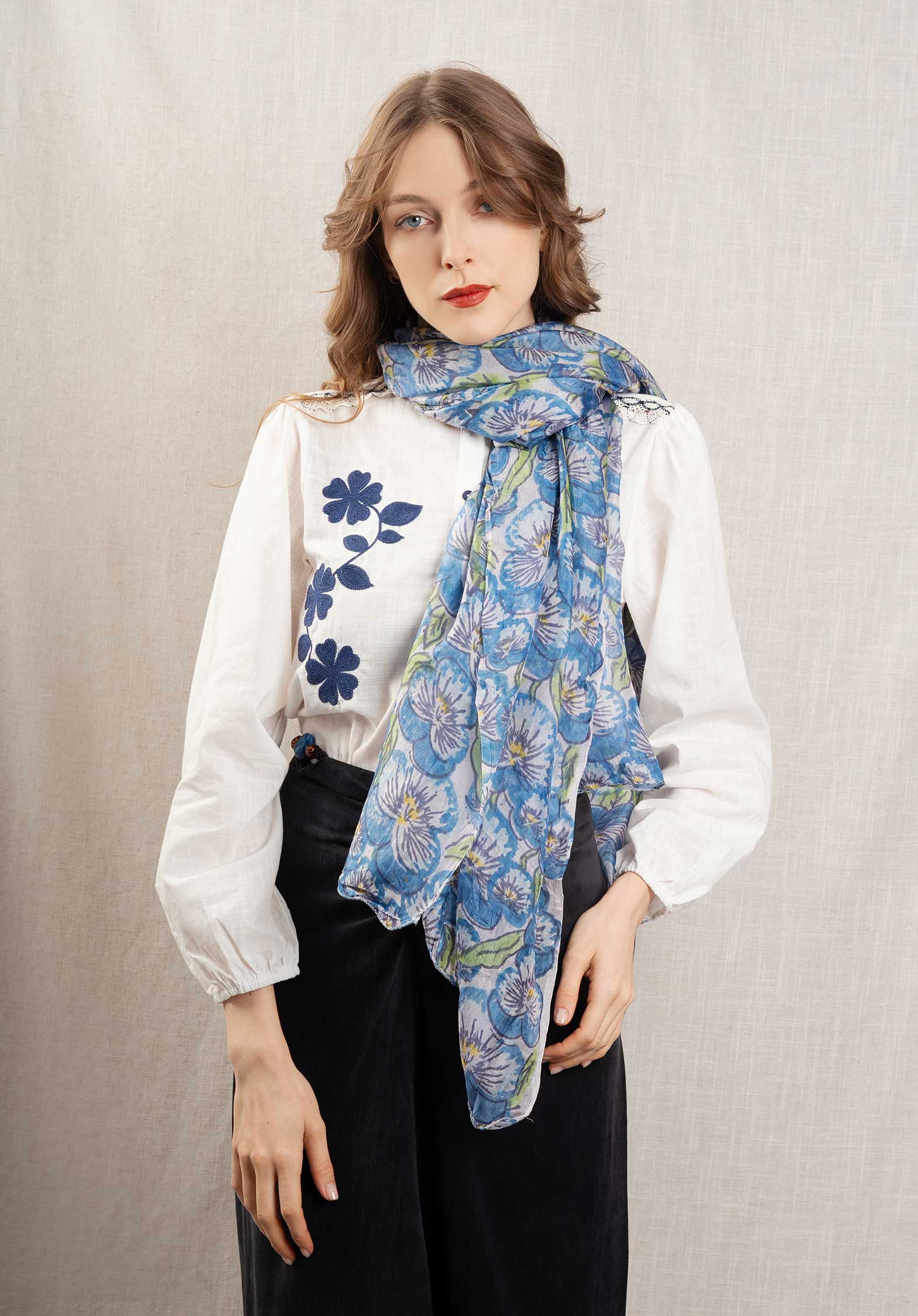
This is not a scarf that merely sits at the neck; it is one that claims its own airspace. The XIWIKJ Dancing-Queens scarf announces itself through a deliberate, generous square silhouette that refuses to be folded into submission. Its proportions are those of a statement piece—ample enough to be worn as a dramatic top knotted at the sternum, generous enough to cascade over the shoulders of a black wool coat, or substantial enough to be tied as a sculptural headwrap that frames the face with intention. The edges are cleanly finished, precise, allowing the silk to fall without distraction. The hand of this silk is where the story deepens. It moves with a liquid weight that is neither flimsy nor stiff—a rare equilibrium that speaks to a higher grade of mulberry silk. When held, the fabric offers a cool, smooth resistance before releasing into a soft drape that catches the light in uneven, painterly flashes. The weave is tight yet breathable, the surface luminous without being glossy. It whispers against the skin, a sensation that elevates the act of dressing from routine to ritual. Construction here is deceptively simple: a pure square of silk, printed with a motif that suggests motion—abstracted figures in a state of perpetual dance, their limbs dissolving into washes of colour. The print is not applied but absorbed, the dyes bleeding into the weave with the depth of a watercolour on paper. This gives the scarf a dimensional quality; the pattern shifts as you move, revealing new compositions with each fold. The corners are weighted just enough to hold a knot in place, a subtle engineering detail that makes styling intuitive rather than frustrating. On the body, this scarf transforms. Worn loose, it becomes a second skin, a whisper of pattern across a neutral cashmere sweater. Tied at the handle of a structured tote, it becomes an accessory to an accessory—a flash of colour against leather. In warmer months, it can be worn as a pareo over a swimsuit, the silk clinging to damp skin with an almost magnetic ease. The palette is complex, a spectrum of jewel tones and softened neutrals that work across seasons: deep indigos, burnt ochres, faded roses, and a grounding charcoal. It is as right with a linen blazer in July as it is with a turtleneck in December. Style it with a sharp-shouldered blazer and wide-leg trousers for a look that balances structure with fluidity. Or let it be the only colour in an otherwise monochrome wardrobe, a deliberate interruption of beige and black. This is a scarf for the woman who understands that an accessory is not an afterthought—it is the point.